
Protecting Women: What the Senate Hearing Revealed About Abortion Pills
Recent polls show that 7 in 10 Americans across the political spectrum agree: a doctor's visit should be required for a chemical abortion prescription.
Why the pushback?
On Wednesday, January 14th, 2026, the Senate Health, Education, Labor, and Pensions Committee held its first hearing of 2026 on Protecting Women: Exposing the Dangers of Chemical Abortion Drugs. Dr. Monica Wubbenhorst, an Adjunct Clinical Associate Professor at Indiana University School of Medicine, served as a witness for the hearing.
This hearing holds great significance in the pro-life movement. After Dobbs was passed, overturning Roe v. Wade, states were able to enact laws banning abortion. With readily available online access to abortion pills, abortions are still available in every state, no matter their laws. Worse, women are afraid of being prosecuted for taking online abortion pills from the mail, and some report that they were afraid to seek medical help when complications arose. There is no reporting system and no way to track how many women are taking abortion pills from the mail in various states.
There is a growing divide between public messaging on the safety and effectiveness of abortion drugs and unresolved questions about oversight, reporting on outcomes, and the key issue: the safety and health of women and their unborn children.
During the hearing, Senator Jim Banks (R-Ind.) used his time to draw attention to regulatory and safety issues around the chemical abortion drug mifepristone, particularly as they relate to FDA oversight and reporting practices.
In 2016, the Obama FDA stopped requiring reporting of non-fatal complications from abortion drugs like mifepristone. In 2023, the Biden Administration weakened safeguards around abortion drugs, allowing them to be prescribed online and delivered through the mail, which violates federal law. The Comstock Act of 1873 is a federal law that criminalizes the involvement of the United States Postal Service in obscene matters and articles used to produce abortion. A literal interpretation of the Act could potentially apply to all abortion materials, not just medication abortions.
The Biden Administration’s Department of Justice determined that the Comstock Act only applies when the sender intends for the material sent to be used for an illegal abortion. Still, because there are legal uses of abortion to save the life of the mother in every state, there is no way to determine the intent of the sender. Under the Trump Administration, this could be interpreted differently.
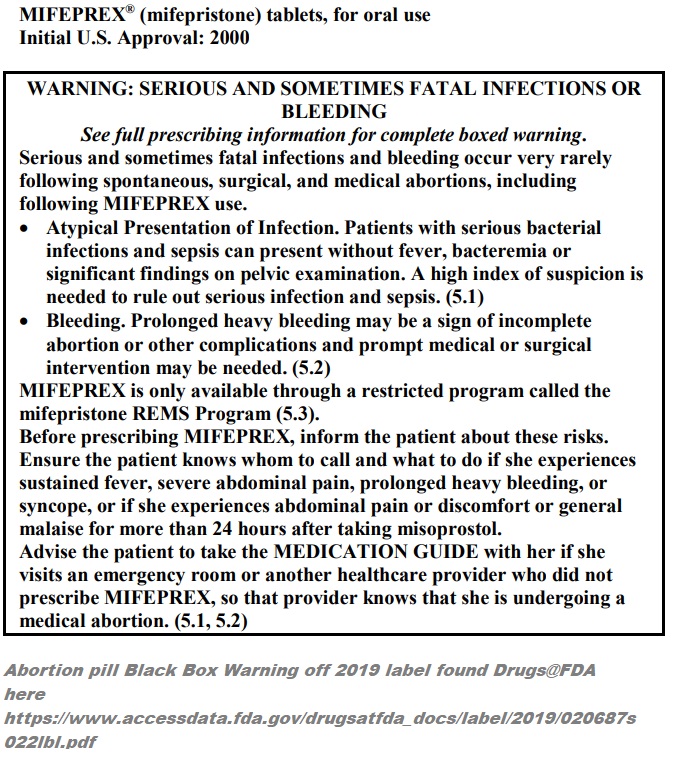
BLACK BOX WARNING
Abortion supporters claim that the medicines in abortion drugs are just as safe, if not safer, than simply taking Tylenol, which data doesn’t back up.
The abortion drug mifepristone comes with a black box label warning, which exists to warn both patients and prescribers of serious and sometimes fatal complications that are associated with the use of a drug.
Tylenol does not have a black box warning. Additionally, on websites and telehealth visits that prescribe the abortion pills, there is no mention of this black box label.
In his opening remarks to the committee, Chairman Senator Cassidy urged HHS Secretary Kennedy to review the safety data of mifepristone as he promised to do so in his confirmation hearing. Senator Banks took it a step further, saying,
“I'm disappointed that the FDA under Dr. Makary's leadership hasn't moved faster to restore the in-person dispensing requirement and strengthen the REMS Program for mifepristone. I hope the rumors are false, some of them are in print, that the agency is intentionally slow walking its study on mifepristone's health risk. I really hope that that's not the case.”
Senator Jim Banks
Throughout the hearing, several witnesses and Senators told stories of women who had been coerced into using the abortion pill by men in their lives who wanted them to have an abortion, including minors. Part of the argument against online access to medication abortion is that men can easily access the medication and give it to a pregnant woman without her knowledge.
Senator Josh Hawley (R-Mo.) asked the Democratic witness, Dr. Nisha Verma, if men could get pregnant as a way of arguing that men can too easily access the chemical abortion regime online. Dr. Verma dodged the question, stating that she treats patients with “many different identities.”
The other major problem with dispensing the abortion pill online is that women have no way of knowing if the medication they are taking is actually mifepristone and misoprostol. As Senator Banks stated, “This is about protecting women from dangerous and even life-threatening drugs and their side effects.”
The week of the Senate hearing, it was discovered that the U.S. Department of Health and Human Services (HHS) had restored Title X funding to Planned Parenthood, funding that had previously been “temporarily withheld” last spring. Reports say that funding was slowly restored, with the final funds being restored in December. The ACLU (American Civil Liberties Union) had filed a lawsuit on behalf of the National Family Planning and Reproductive Health Association, which represents Title X providers. The government was likely to lose the lawsuit, which is why funding was restored, and the lawsuit was dropped.
With the lawsuit dismissed, there are more opportunities for the Trump administration to cut Planned Parenthood funding with specific rules. Whether the administration follows through on this remains to be seen.
Under President Trump, there are many federal opportunities to protect women and their unborn children. Right to Life of Northeast Indiana thanks Hoosiers Dr. Wubberhorst and Senator Jim Banks for faithfully upholding the pro-life mission and standing up for the safety of women and their unborn children.